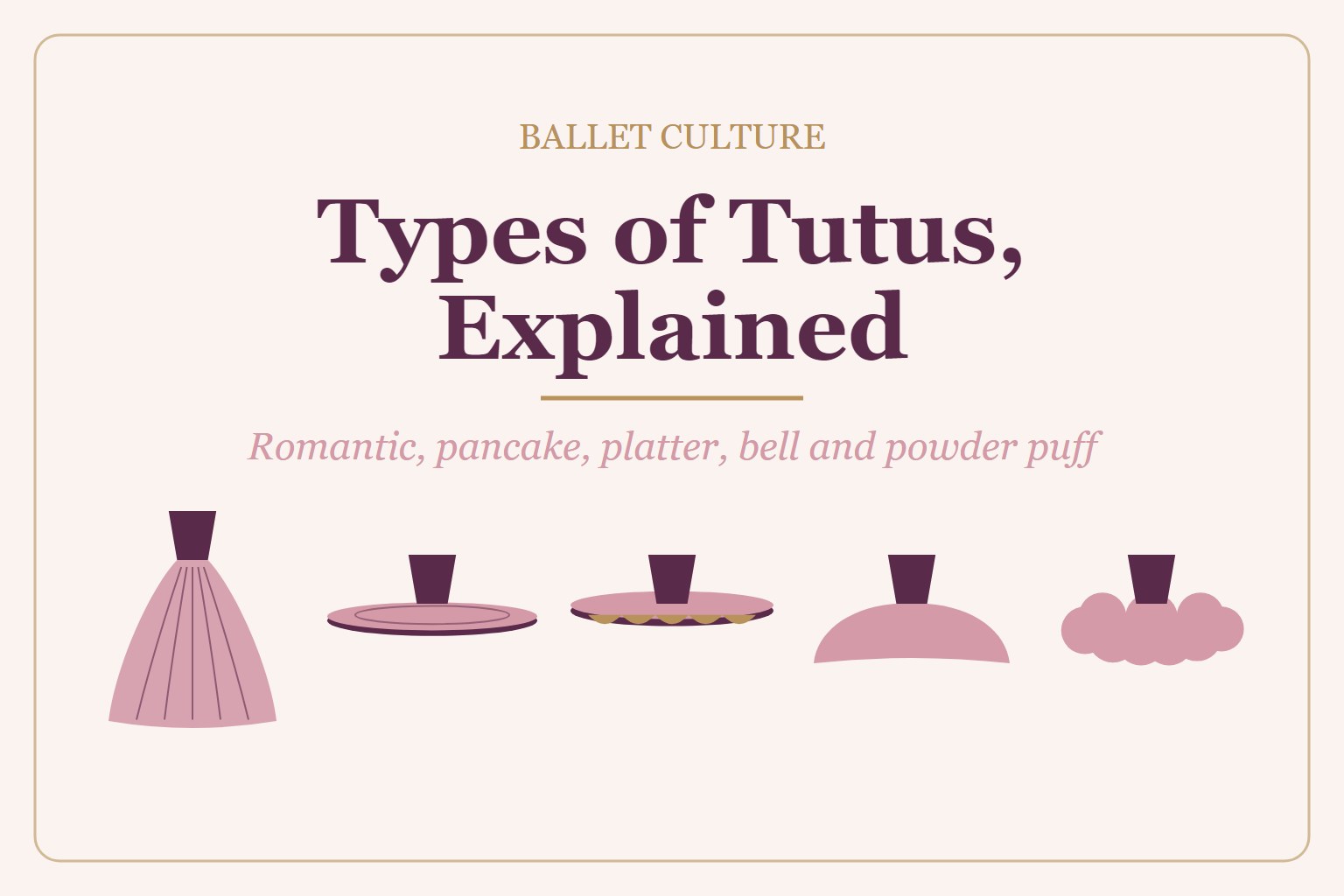
Ballet tutus come in two big families: the long, soft Romantic tutu and the short, stiff classical tutu. The classical family splits into four styles you’ll often see named: the pancake, the platter, the bell, and the powder puff that Balanchine made famous. Once you know what to look for, you can usually tell them apart from your seat, and each one changes how a ballet looks on stage.
I’m an adult hobby dancer. The closest I get to a tutu is a practice skirt over my leotard. But I love watching costumes, and “what kind of tutu is that?” is a question I hear in the lobby a lot. Here’s my guide to the main types, where they came from, and the numbers behind them.

The two families: Romantic vs. classical
The simplest way to sort tutus is by length and shape.
- Romantic tutu: a long, soft skirt of gathered tulle. Wikipedia’s tutu article says the hem falls between the knee and the ankle.
- Classical tutu: a short, stiff skirt that sticks out from the waist and hip. Wikipedia describes it as projecting horizontally, built from layers of stiff tulle sewn onto a pair of briefs and a fitted basque.
The difference isn’t only about looks. A long skirt floats and blurs the legs, which suits ghostly, dreamy roles. A short skirt shows off the whole leg, so the audience can see every extension and every beat of the feet.
The Romantic tutu: where it all started
The Romantic tutu goes back to 1832 at the Paris Opera. Marie Taglioni wore a gauzy white skirt in La Sylphide, designed by Eugène Lami, according to both Wikipedia and the London Museum. Taglioni’s own Wikipedia page notes that her father, Filippo Taglioni, created the ballet for her.


Pittsburgh Ballet Theatre’s guide to tutu styles says the length of that skirt showcased Taglioni’s pointe work. PBT and The Australian Ballet both put the Romantic tutu at three to five layers of tulle. That’s why it moves so softly. When the dancer runs, the skirt keeps drifting for a moment after she stops.
Today’s versions are still based on that 1830s idea. Wikipedia says modern materials make them lighter and sometimes more see-through than the originals. If you’ve read my guide to Giselle, ballet’s original ghost story, this is the look of the Romantic era: pale, floating, and a little unreal.
The classical tutu and its four styles
From the late 19th century, the skirt kept getting shorter. Wikipedia and the London Museum both describe this shift toward the short, flat shape that shows more of the legs. The London Museum adds that the classical style is more popular today than the Romantic one.

Here are the four classical styles, as Pittsburgh Ballet Theatre and Wikipedia describe them.
Pancake. This is the one most people picture: flat, stiff, and wide, like a disc around the hips. PBT says it sits at hip level and often has a steel hoop woven through the tulle. Wikipedia also describes it as supported by a hoop and very flat, with few ruffles.
Platter. Close to the pancake, but it sits higher. Wikipedia places it at the waist instead of the hip. PBT says it often has a hoop too, plus a decorative overskirt on top.
Bell. Still short, but the edge curves down instead of sticking straight out. According to PBT, costumers get that shape with pleated tulle tacked more loosely, and no hoop at all.
Powder puff. Also called the American, Balanchine, or Karinska tutu. Wikipedia describes very short ruffles of tulle loosely sewn onto the briefs for a soft effect. PBT calls it soft, full, and relaxed, with no hoop. More on this one below, because it has a great backstory.
Balanchine’s powder puff: less tutu, more dancing
George Balanchine wanted to see his dancers move. Costume designer Barbara Karinska gave him a lighter tutu that didn’t hide the legs. Her Wikipedia page says the skirt has six or seven layers of gathered net, each a half inch longer than the one before. Because the layers hold each other up, no wire hoop is needed. The Australian Ballet agrees that Karinska’s skirts used only seven layers of netting and no rigid hoop.


According to Wikipedia, the powder puff first appeared in 1950 in Balanchine’s Symphony in C and became a standard design in ballet companies around the world. Karinska worked with Balanchine on more than seventy ballets, and she shared the 1948 Academy Award for color costume design for Joan of Arc.
When you see a Balanchine ballet, watch the skirts during fast jumps. They bounce and settle instead of staying perfectly flat. That softness is the whole point.
How many layers? A quick comparison

Layer counts depend on the style and the maker, but the sources give a rough picture:
- Romantic: three to five layers, according to The Australian Ballet and PBT.
- Powder puff: six or seven layers of net, according to Karinska’s Wikipedia page.
- Classical (pancake style): 10 to 12 layers of stiff tulle, according to Wikipedia. The short lower layers hold up the top ones so they jut out from the hip.
The fabric changed over time too. The London Museum says early skirts were made mainly of tarlatan, a heavily starched open-weave cotton. In the early 20th century, cotton, silk, and nylon tulle largely took over.
How tutus changed over 200 years

A few dates help put the styles in order:
- 1832: Taglioni wears Lami’s Romantic skirt in La Sylphide in Paris.
- 1881: the word “tutu” shows up in writing for the first time, according to Wikipedia.
- Late 1800s: the classical tutu gets steadily shorter.
- 1907: Anna Pavlova first dances The Dying Swan, choreographed by Mikhail Fokine, according to the London Museum.
- 1950: Karinska’s powder puff debuts in Symphony in C, according to Wikipedia.


The word itself is a small mystery. Wikipedia says nobody knows where “tutu” comes from. One theory links it to “tulle.” The London Museum mentions another: the French word “cucu,” meaning bottom. I like that the most famous ballet costume has such a cheeky possible origin.
Pavlova’s swan costume is a good example of how tutus evolved. According to the London Museum, she danced The Dying Swan for 24 years in several different swan tutus, and only three are known to survive. The museum holds one of them. It credits the maker as Madame Manya, a London tutu maker whose work later became a template for others.
What goes into making one tutu

This is the part that surprised me most. A tutu is a serious piece of engineering, and almost all of it is done by hand.
- Hours: The Australian Ballet says an elaborate tutu can take up to 120 hours to construct. The London Museum says an experienced maker may need 30 to 40 hours for the skirt alone.
- Fabric: The Australian Ballet says a classical tutu can use over 25 meters of fabric. The London Museum puts a classical skirt at around 50 meters of pleated net, so the number clearly depends on the design.
- Lifespan: Tutus are made to be worn thousands of times and last about 20 to 30 years, according to The Australian Ballet.
The Australian Ballet also describes the fittings. Costume makers check for anything that could rub or scratch, and they keep fitting the tutu until the very end, because the dancer has to jump, turn, and sometimes roll on the floor in it. Even a simple-looking black Swan Lake tutu, it says, stands for hundreds of hours of work. If you’re seeing Swan Lake soon, my Swan Lake guide covers the story and the two endings.
It’s the same story with pointe shoes, which dancers go through by the dozen: what looks effortless on stage is built on a lot of handwork backstage.
How to spot each tutu from your seat

Next time the curtain goes up, try this:
- Look at the hem. Below the knee and floating? Romantic. Above the thigh? Classical.
- Look at the edge. Perfectly flat like a plate? Pancake. Flat but riding at the waist with an overskirt? Platter.
- Look at the curve. Short but sloping down? Bell.
- Watch a jump. Soft and bouncy with no hard edge? Powder puff.
If you’re new to ballet and want to see a few of these in action, my list of 10 ballets to start with is a good place to begin. And if you take class yourself, my guide to the five ballet positions explains the footwork those short skirts were designed to show off.
Spotted an error? Let me know.
Leave a Reply